I Automated My Weekly Report in 20 Minutes
Write code once. Your agent runs it on a schedule. No servers. No cron jobs. No "it works on my machine."
Write code once. Your agent runs it on a schedule. No servers. No cron jobs. No "it works on my machine."
Every Monday morning, you do the same thing. Open Google Analytics. Open Stripe. Open your database. Copy numbers into a spreadsheet. Make a chart. Send it to your co-founder.
It takes 45 minutes. You've done it 104 times. That's 78 hours of your life, gone.
Your agent could do this. But writing a script, setting up a server, configuring a cron job, handling failures — that's a whole project.
Or it was.
The Problem
Repetitive tasks are the worst kind of work. They're not hard. They're not interesting. They just need to happen, every week, on time, without fail.
You could automate them. But automation has a tax:
- Write the script
- Set up a server to run it
- Configure a cron job
- Handle failures and retries
- Monitor it to make sure it's still running
- Update it when something changes
By the time you've done all that, you could've just done the task manually for another year.
So you don't automate it. You just keep doing it. Every Monday. Forever.
The Solution
Penut lets you deploy code functions that run on a schedule. No server. No cron. No infrastructure.
You write a TypeScript function. Your agent deploys it. You set a schedule — every Monday at 9 AM, every day at midnight, whatever. It runs. It sends you the results.
If it fails, you get notified. If it needs to call an API, it can. If it needs to query your database, it can. If it needs to post to Slack, it can.
All from one function. All managed by Penut.
What You Get
No infrastructure. No servers to provision. No Docker containers. No "let me SSH in and check the logs." Penut runs your function. You just write it.
Built-in scheduling. Set a cron schedule in plain English. "Every Monday at 9 AM." "Every day at midnight." "Every 15 minutes." Done.
Access to everything. Your function can query your database, call integrations, send emails, post to Slack, generate images. It has the same access your agent does.
Automatic retries. If your function fails, Penut retries it. If it keeps failing, you get notified. No silent failures. No "I didn't know it stopped working three weeks ago."
Scoped permissions. Your function only gets access to what you grant it. It can't accidentally delete your database or post to your personal Twitter. You control the blast radius.
Real-World Example
You need a weekly revenue report every Monday at 9 AM.
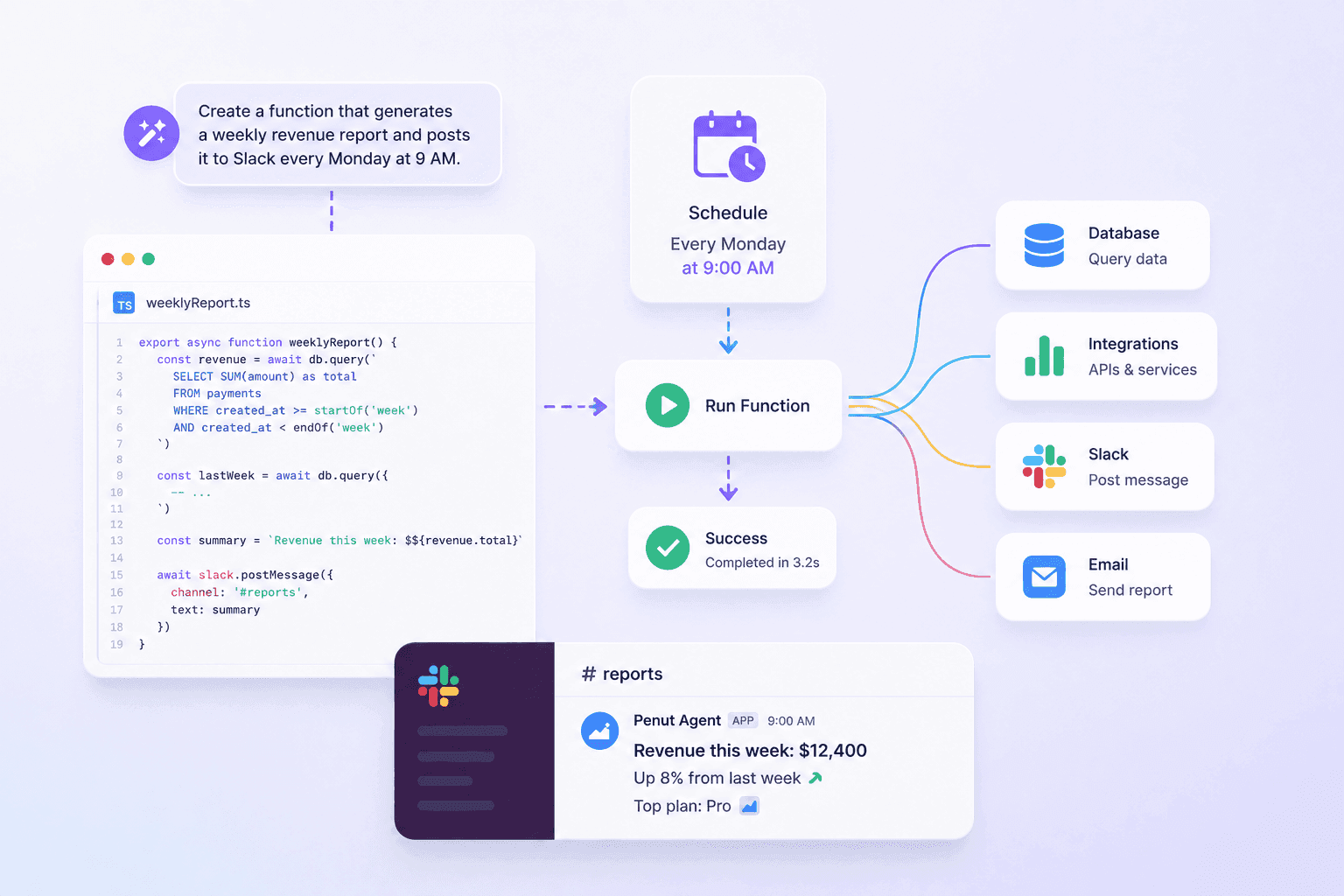
You tell your agent: "Write a function that queries our database for this week's revenue, compares it to last week, and posts a summary to Slack."
Your agent writes the function. You review the code. You deploy it. You set the schedule: every Monday at 9 AM.
Monday comes. 9 AM hits. Your function runs. It queries the database. It calculates the numbers. It posts to Slack: "Revenue this week: $12,400. Up 8% from last week. Top plan: Pro."
You open Slack. The report is there. You didn't do anything.
Total setup time: 20 minutes. Total weekly time saved: 45 minutes. Total Mondays you'll never dread again: all of them.
What This Means for You
Automate without the overhead. No servers. No DevOps. No "who maintains this?" Just code and a schedule.
Your agent writes the code. You describe what you need. Your agent writes the TypeScript. You review it. You deploy it. No coding skills required.
Set it and forget it (mostly). It runs on schedule. If something breaks, you know. If everything's fine, you never think about it.
One function, many uses. Weekly reports. Daily backups. Hourly data syncs. Monthly invoices. Same workflow for all of them.
Next Step
Tell your agent about a repetitive task you do every week. Watch it write the function. Deploy it. Set the schedule. Never do that task again.
Ready to automate the boring stuff? [Sign up for Penut](https://penut.ai) and deploy your first scheduled function today.
Next up: Where Does Your Agent Put Things? — file storage that actually makes sense.